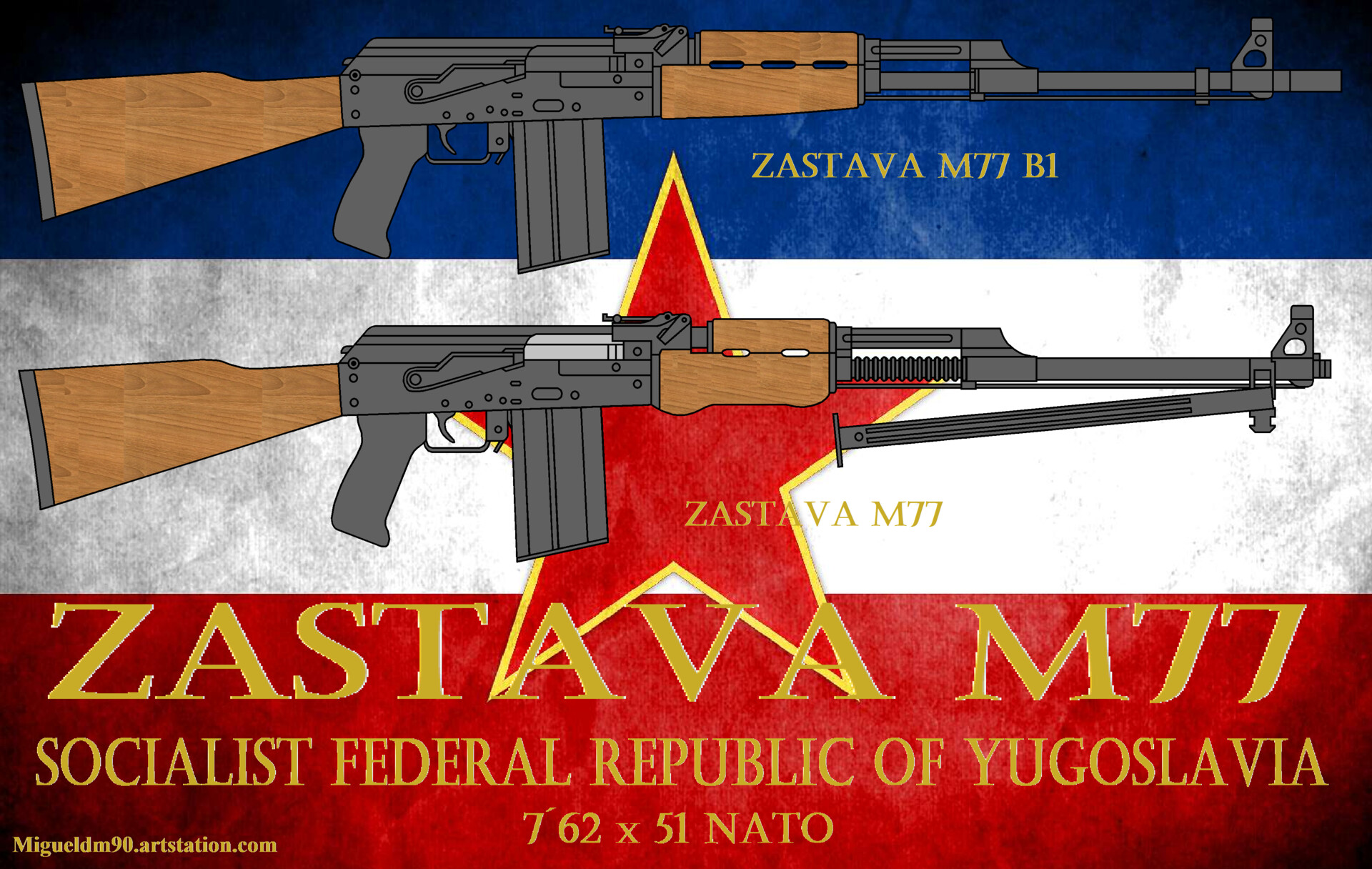
Yugoslav Zastava M77 rifle family
Hi again, everybody. My next work by Foreign Kalashnikovs will show you some old Yugoslav "battle rifles" that, like the Iraqi Tabuk sniper rifles I showed you earlier, are also considered a rarity of Kalashnikov rifles from around the world, but along with the Zastava M70 assault rifles and all their variants were also the standard weapons of the former Yugoslav People's Army and the current Serbian armed forces. These weapons were also widely used by the troops of all the sides faced in the Yugoslav Wars, which, as I told you a long time ago, are currently described as the bloodiest warlike conflict in the history of Europe after World War II. Well, today I will show you the Zastava M77 light machine gun and the Zastava M77 B1 combat rifle, which derives from this machine gun and fires only in semi-automatic mode. These weapons first manufactured in the former Yugoslav Socialist Federal Republic, in 1977 and by the local arms manufacturer Zastava Arms, are very similar to the Zastava M70 assault rifle, but with much longer barrels than those of the Weapons from 1970 and they have a difference that turns out to be quite striking. This difference is none other than its characteristic straight magazine that, in addition to having a capacity for 20 rounds, (although there are also shorter magazines that have a capacity for only 10 rounds) is very similar to the magazines of the old "battle rifles" or "combat rifles" (much larger, heavier, more powerful, precise, longer-range infantry weapons and obviously much more expensive than traditional assault rifles) US M-14, Belgian FN FAL, British L1A1, (version English Belgian rifle) HK G3 German and other similar weapons. The reason these 1977 Yugoslav weapons use straight magazines is because they are redesigned and recalibrated weapons to fire the 7'62 x 51 NATO western cartridge. This is why the Zastava M77 light machine gun and the Zastava M77 B1 combat rifle are derived both from a Soviet Kalashnikov rifle (by design and mechanics) and from the Western battle rifles I just mentioned (for the caliber it has, the magazine he uses and the ammunition he fires). The Zastava M77 light machine gun incorporates a folding bipod under the muzzle, while the muzzle of the Zastava M77 B1 combat rifle incorporates a flame arrester that is almost identical to that of many western carbines, assault rifles, and light machine guns. Another very curious fact about these Yugoslav weapons from 1977 is that the Zastava M77 machine gun, like the Zastava M70 assault rifle, also fires 620 rounds per minute, but said machine gun and its semi-automatic variant have an incredible effective range of 800 meters, (that is, the bullets from the Zastava M77 rifles and machine guns reach the same distance as the bullets from the Soviet Dragunov sniper rifle do) regardless of the mode of fire in which these 1977 guns are fired. The reason the machine gun Zastava M77 light and Zastava M77 B1 combat rifles are considered rarities of Kalashnikov rifles worldwide because, with the exception of the Serbian armed forces, very few of these weapons have been seen used by members of the Cyprus law enforcement agencies. and Mali. It is possible that from 1977 until today, the Zastava M77 machine gun and the Zastava M77 B1 rifle have been exclusive weapons for the armed forces of the former Yugoslavia and of present-day Serbia, as is the case with North Korea and the rifles of Type 98 assault. And currently, in the Serbian armed forces, these impressive 1977 Yugoslav weapons are being replaced by a new assault rifle called the Zastava M05 N1, which is a much more modern and advanced version of the Zastava M77 B1 rifle and also shoots only in semi-automatic mode. I hope you like my new work and another cordial